Move-Out Drywall Patching
Anchor holes, scuffed corners and dings from furniture, patched and sanded so the walls are ready for paint before a walk-through or a listing.
Holes, popped nails, settling cracks and water-stained ceilings, patched with the texture blended in, so the repair is gone once the wall is painted.
A drywall contractor who works around Shiloh looks at the wall and prices it with you before anything is cut.
Call 7 days, 7am–9pm
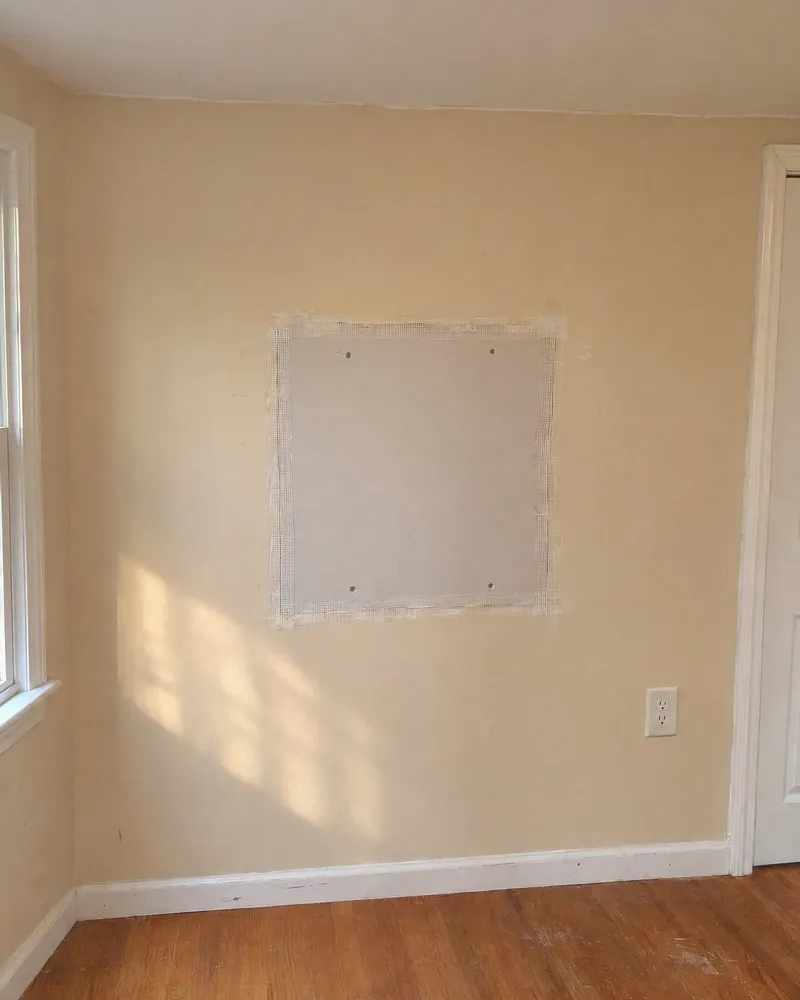
A patch shows when its surface does not match the wall around it: a ridge at the edge, a smoother sheen, or a texture that stops in a line. The repair is feathered wide, sanded flat, textured to match and primed so the new compound absorbs paint like the old wall does. Flat and matte paint hide a patch best. A satin or eggshell wall usually needs the whole wall repainted, corner to corner, for an even sheen.
No. Single small repairs are common. Most people add the other marks they have been ignoring once someone is coming out anyway, and grouping them keeps the cost per repair down because the drying time is shared.
Most texture can be reproduced: orange peel, knockdown, light sand finish and smooth. The contractor tests the spray or roll pattern on a scrap piece first, then applies it to the patch and blends the edges. Popcorn ceilings can be patched, but the new section is usually visible up close in raking light.
A small patch is usually spread over a few brief trips, because compound needs to harden between coats. Setting-type compound can shorten that for small repairs. Larger cut-outs, ceiling sections and anything that needs texture take longer. The contractor gives the expected number of visits with the quote.
Some. Sanding joint compound makes fine white dust. Floors are covered, furniture is moved or wrapped, and sanding is done with a vacuum sander or wet sponge where the repair allows it. Plan to wipe the nearest surfaces once the job is done.
When the work is done, the patch has primer on it and can take paint. Many people paint it themselves; painting can also be priced in if you mention it at the start.
Most walls in a rental or a house going on the market need the same short list of fixes: anchor holes from shelves and TV mounts, a round hole where a bedroom door handle hit, nail pops along the ceiling line and scuffed outside corners. Move-out inspections focus on holes and damage, not on normal wear such as faded paint. Listing photos show every shadow on a wall that faces a window.
What matters most is the order of work. Drywall repair goes first, then primer, then paint. If painters are already booked, the patching has to be finished and dry before they arrive, which usually means scheduling the repair at least a few days ahead of them. Small nail holes from pictures can often be filled by the painter. Anything larger than a coin, anything with a torn paper face and any crack that has come back is worth a proper repair.
Leave alone what is not damaged. Repainting a whole room because of one patch is a choice, not a requirement, as long as the paint color and sheen are known. Keep the paint can or note the color name before the move; matching an unknown color takes more time than the patch.
Every request falls into one of these. Each page explains the cause, the fix and what to watch for.
Anchor holes, scuffed corners and dings from furniture, patched and sanded so the walls are ready for paint before a walk-through or a listing.
Popped screws, raised nail heads, taped seams that split and the diagonal cracks that run off door and window corners.
Doorknob strikes, a shoulder through the hallway wall, old cable runs and cut-outs left from plumbing work, closed with backing and new board.
Brown rings, soft spots and sagging sections on ceilings and walls after a leak, replaced once the source is dry and fixed.
Shiloh is mostly a young housing stock. The village had 2,655 residents in 1990 and 14,098 at the 2020 census, and its count of homes roughly doubled between 2000 and 2020, from 2,928 to 5,942 housing units. Nearly all of that is standard gypsum drywall, taped at the seams and finished with a sprayed or rolled texture.
Newer drywall has its own patterns. Studs and joists lose moisture and shrink for the first several winters, which pushes nails and screws out through the paint and opens hairline cracks at the corners of doors and windows. These are cosmetic in most houses and are fixed by resetting the fastener and refinishing the spot.
Older houses still turn up, mainly in the original village blocks and in towns nearby such as Belleville and Lebanon, where some walls are plaster on wood lath rather than drywall. Plaster cracks are repaired differently: loose plaster is reattached or cut back, and the patch is brought out to the plaster's thickness one coat at a time. In a house old enough to have lead-based paint under the newer coats, the paint is tested before any sanding.
Size decides the method, the number of coats and how many trips the drying takes. Price ranges below are national figures from Fixr's drywall repair cost guide, not prices for this area; the actual figure is set at the wall.
Filled or spot-patched, two or three thin coats, sanded and primed. Texture is touched in by hand or with a small spray can. Fixr's national cost guide puts hole repair at roughly $60 to $200 and nail pop repair at roughly $75 to $140.
Cut square, backed with wood or a clip, a fresh square of drywall fastened in, then taped and coated. More coats and more drying time. Texture is sprayed and blended past the edge of the patch.
The damaged board is removed back to framing, new board is hung and fastened, and every seam is taped and finished. Usually several visits. For water damage confined to one room, Fixr lists about $400 to $800.
A typical visit follows the same sequence whatever the size of the patch.
Repairs are booked in Shiloh on both sides of Greenmount Road and in the towns around it. O'Fallon sits just to the north, Belleville to the southwest, Swansea to the west, Mascoutah to the southeast and Lebanon to the northeast, with Fairview Heights and Summerfield a little farther out.
The page on how the service is set up covers what is and is not part of the work.
Ceilings fail differently from walls. Water collects on top of the board and spreads before it shows, so a ring on the ceiling can spread well past the spot where the leak sits. Ceiling board that has been soaked can sag between joists; once it sags, it is replaced rather than patched.
Cracks where an inside partition wall touches the ceiling, which open in winter and close in summer, are often truss uplift: the roof trusses bow slightly as the attic changes temperature. They are fixed with a flexible joint or a corner treatment that lets the ceiling move without tearing the tape again.
Seams that show as straight lines across a ceiling are usually tape that has loosened or a joint that was not feathered wide enough. Sprayed ceiling textures, including popcorn, are patched and re-sprayed. Popcorn texture in older houses is tested for asbestos before it is disturbed.
Stains and sagging sections are covered on the water damage page.
The Metro East has cold winters, wet springs and hot summers, and drywall shows the effects of each in a different way. The figures below are the 1991–2020 NOAA normals for the Belleville SIU Research station, about six miles from the village.
December, January and February all average lows below freezing. Furnace-dry air shrinks framing and opens seam cracks and corner cracks; truss uplift cracks appear at ceiling corners.
April and May are the wettest months, with about five inches of precipitation each. This is when roof, window and gutter leaks show up as ceiling stains and bubbled paint.
July averages a high of about 90°F. Air conditioning condensation lines, drain pans and attic ductwork can sweat and stain the ceiling below them.
Call or send a snapshot of the damage. The price is set on site, with the wall in front of you, before any work starts.
A drywall contractor who works around Shiloh looks at the wall and prices it with you before anything is cut.
Call 7 days, 7am–9pm